|
|
Eugenia Lucas
Sweet Robin, you soar
One more laugh, my friend,
Of all the muses who have inspired me through four-plus decades, Robin Williams far surpasses the others. Forty-plus stories posted on this website can be directly
attributed to his influence, because he ran the gamut of comedy to tragedy - as do my writings. I first became acquainted with his talent - as did so many - via Mork and Mindy. A teenager at the time, being forced to study music by my mother, his ability to play the harmonica
delighted me. In the episode "Looney Tunes and Morkie Melodies" (from Season 2), he sings the "Shazbot Blues" and plays with the band, moving his hips and capturing my
attention. There are videos on Youtube which show him playing the harmonica and singing improvised blues for the troops on his many USO tours to Afghanistan and Iraq, as well.
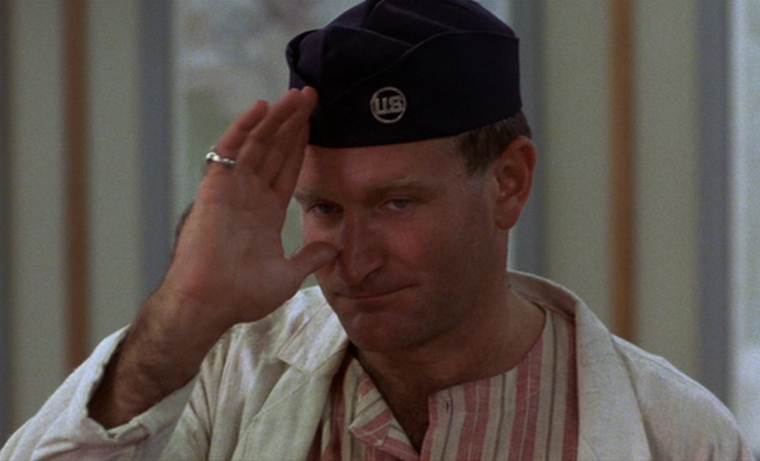
On Mork and Mindy, and in many movies and other appearances, he used a hand salute which no military personnel would dare mimic. He placed his thumb on his
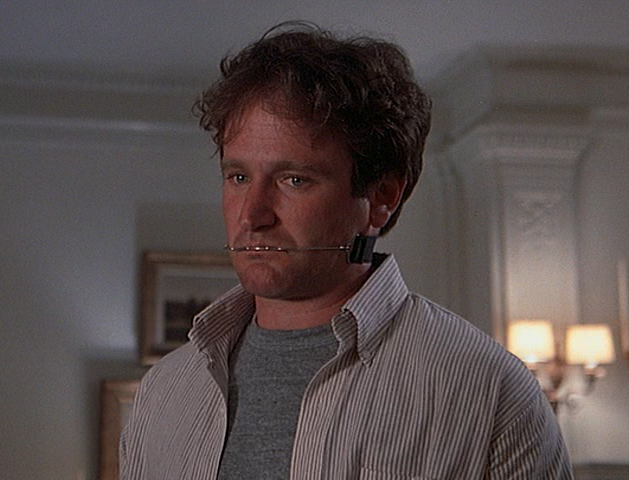
nose, so quickly it might not always be noticed, but the gesture resonated with my attitude toward society. His talent blew many away. He sang in Popeye, difficult to do when trying to also maintain a specific character voice. In The World According to Garp, after
the crash which causes his character's jaw to be wired shut, he conveyed with those Adriatic Sea-blue eyes anger and frustration, never having to utter a word. After seeing Robin, Billy Crystal and Whoopi Goldberg do Comic Relief specials on HBO, I penned a screenplay for the three of them - of course, never
produced. Navigating the world of agents and commercialism has never appealed to me, or been my forte. So, it lay buried in a drawer until I rewrote it as a
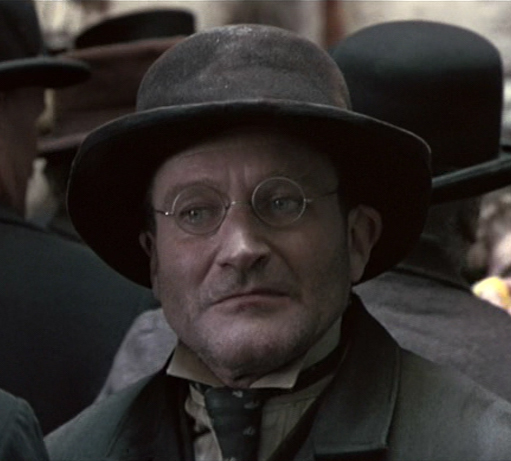
short story. While Robin slipped lines from his stand-up performances into a number of his movie roles, when he turned to darker themes, I was intrigued. The adaptation
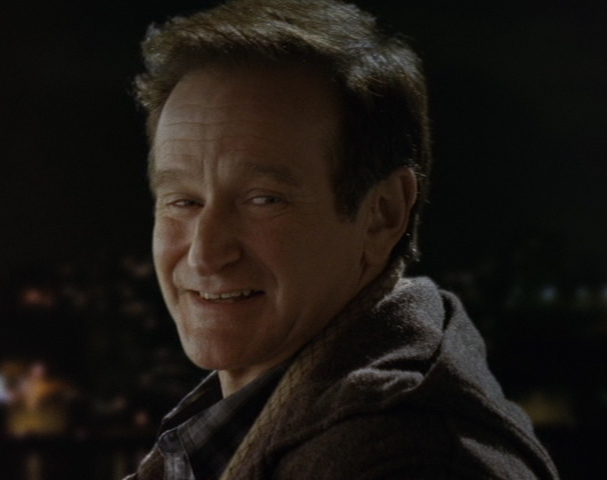
of Joseph Conrad's The Secret Agent entranced me. Robin is unbilled, and appears for approximately 11 minutes in the film - at the beginning and the end, and
a bit in the middle - but his posture, stride, delivery of his lines are compelling. The rest of the movie is a muddle, but Robin stands out. Much has been written about his Oscar nominated roles in Good Morning Vietnam, Dead Poets Society, Good Will Hunting and The Fisher King. In the latter, as well as Patch
Adams, the more recent World's Greatest Dad and Angriest Man in Brooklyn, Robin shows a bit of flesh - as well as in the gag reel from Mork and Mindy's first season (found on
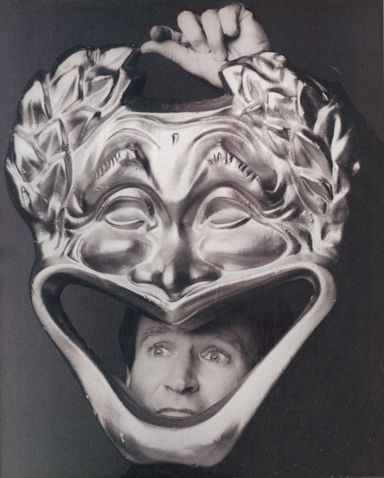
Youtube). I've a sense he did it a bit for shock value, and to make people realize their bodies are what they are. Years before word was released about his depression, I recognized it in his eyes. The February, 1993, issue of "Premiere" magazine featured a photo layout shot
on the sets of Toys, along with a portrait of Robin by Firooz Zahedi. I remember picking up a copy of the issue and taking it to the warehouse where I was
manager at the time, sitting in my office and swallowing my heart at the sight of Robin peering through the mouth of the comedy mask, his expression totally
serious.
How I related to that image cannot be described with in mere words.
I did some serious research and managed to contact Mr. Zahedi, purchasing a print of the photo - and going into debt to do it! That photo hangs on the wall
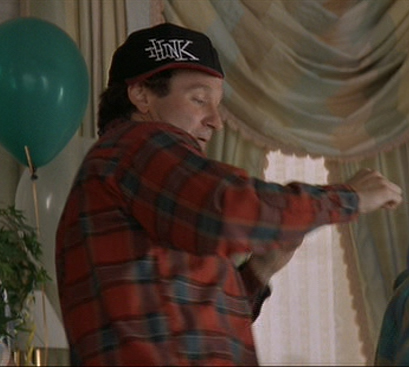
above my desk. On an episode of "Oprah," Robin was promoting Toys, and wore a ballcap emblazoned with the word "Think". He wore a similar one in Mrs. Doubtfire. I
didn't get an exact duplicate made, as far as the font, but I hoped others would be inspired to think when they saw me wearing my version of the hat. A number of quotes attributed to Robin - because he spoke them on stage or in films - touched me:
Then, there's the lyrics to "The Mirror Song" from Toys, which Robin and Joan Cusack sing partially on screen, with the soundtrack version boasting only a bit
of their voices. I cut the two together, so what I listen to each morning as part of my wake-up regimen is Robin's voice belting out: "There's no reality, just an illusion.
The saddest thing about Robin is how he was misjudged. What some termed bipolar disorder - or "demons" - didn't understand his
rampant creativity, which he handled in a most disciplined fashion. Like any true genius, he endured a type of depression which those who have not
experienced it cannot fathom. Glimpses of it can be seen when he
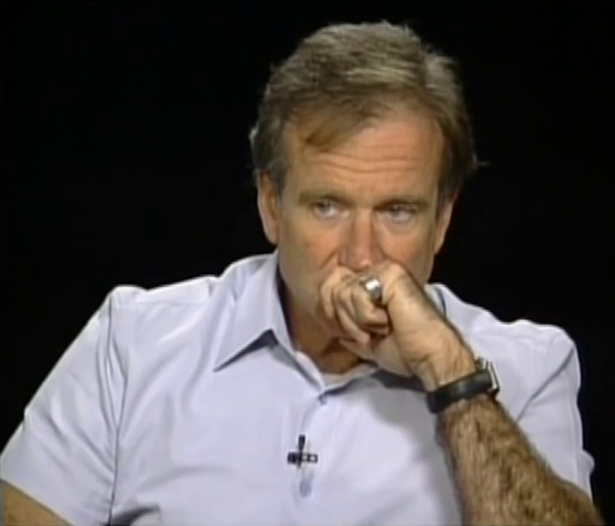
talked with Charlie Rose in 2002 about One Hour Photo. The camera cuts to Robin while director Mark Romanek is emoting
on Robin's "explosive" tendencies. The expression on Robin's face clearly expresses his discomfort. Another such revelation of his inner state can be seen in the special features on the two-disc set of Mrs. Doubtfire. Director Chris Columbus is seated beside Robin on a couch,
and while Columbus is speaking, Robin sort of caves in on himself. Yet, he was gentle, kind, and generous. The many charities he supported, the roles he performed for friends - as in the movie Noel, not wishing it to be
promoted as a Robin Williams film, so the public could judge it on its own merits - were too numerous to list. Some of his movies included themes of death: Angriest Man in Brooklyn (specifically, a reference to the years 1951-2014), and World's Greatest Dad,
where his character's son dies with a belt around his neck. Also somewhat disturbing is a scene from the docu-comedy Certifiably Jonathan, where Robin
talks Jonathan Winters out of hanging himself with a rope in the Museum of Modern Art. In Father's Day, Robin's first scene involves him trying to commit
suicide, seeing no future for himself as a failed writer.
Much has been written by those who didn't find him funny, criticizing many of his films as less than stellar, but it must be remembered that he wasn't solely
responsible for the final product. The writer, director, editor, and other members of the creative team contributed to the success or failure of a production. Furthermore,
Robin said in many interviews he chose projects based on the opportunity to learn something new, to stretch his horizons. Sometimes, that means risking failure.
Robin spoke occasionally about receiving a "Buddhist gift" - acquiring a nugget of truth from someone at various points on his life's journey. He gave me the ultimate
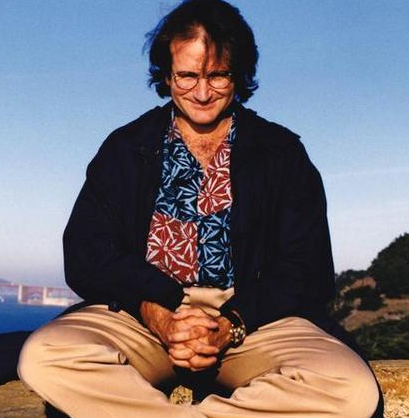
Buddhist gift, enabling me to see the truth about human existence. A photo snapped by Al Seib of the Los Angeles Times in 1991 shows Robin perched on a rock
near San Francisco Bay. I dubbed it, "The Smiling Buddha."
No one can claim Robin was a phony, or that he hid the truth from others. He'd spoken openly about his addictions, and slipped references to both depression
and suicide into various interviews. The serious disease with which he'd been diagnosed dimmed his prospects of continuing to
express his innate goodness and creative genius. Such awareness can destroy one's soul. I know from experience of what I speak.
While I'll forever regret not buying tickets to Robin's 2009 "Weapons of Self Destruction" performance in South Bend,
Indiana, I am eternally grateful for his influence on my writings and the tough decision I had to make about my future.
I've got the tattoo to prove it.
high above this mundane world.
Please, take us with you.
would help the people to mend.
You will so be missed!
There's no real sanity, just plain confusion."